What rhymes with AI?
"He started shaking and said, 'I spent all week doing that.'"
That's how a founder described an accountant's reaction to his software demo.
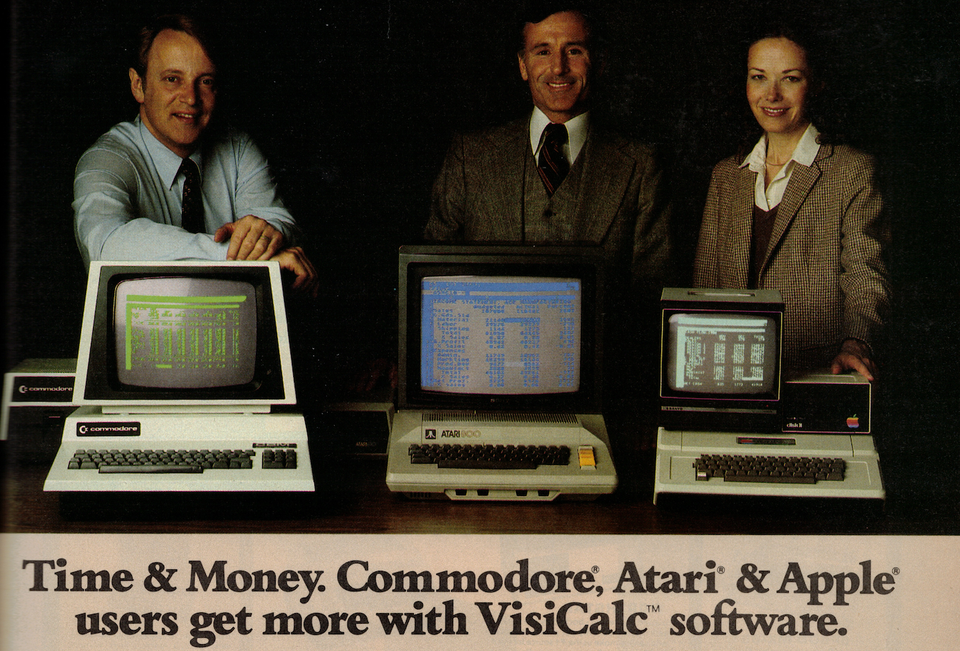
The year, however, was 1979. The founder was Dan Bricklin. The product was VisiCalc, the first electronic spreadsheet. His inspiration was watching a Harvard professor erase and rewrite an entire financial model on a blackboard because one input changed.
The reaction to VisiCalc looks a lot like the reaction to AI today. Accountants split into two camps. Allen Sneider, the first registered VisiCalc owner and an accountant himself, called it "a godsend." Others saw a threat. A computer could do in seconds what took a person a full day, it didn't make transposition errors, and it didn't bill by the hour. The math seemed obvious: fewer hours of work, fewer accountants.
That prediction, of course, was completely backwards.
When VisiCalc launched, the Bureau of Labor Statistics counted just over 980,000 accountants in the US, working alongside 1.8 million bookkeeping workers who did the arithmetic behind them. Clerks outnumbered accountants nearly two to one. By 2024, BLS counted 1.6 million accountants and 1.6 million clerks. The machine ate the arithmetic. The clerical layer shrank while the profession grew by more than 60%, and the field flipped from two-thirds arithmetic to half judgment. BLS expects the split to keep widening: accountants up 5% over the next decade, clerks down 6%.
Why the doomsayers got it wrong
They assumed the amount of accounting work was fixed. It wasn't. When analysis got cheap, clients bought more of it. Sneider's clients started calling with questions they never would have paid to answer on paper. What if we cut prices 2%? What if we opened a second plant? Every answer created three new questions.
And business itself got harder. Since 1980 we added multi-entity structures, more complex business models, ASC 606, ASC 842, CECL, fair value measurement, and close calendars measured in days instead of weeks. The spreadsheet made a vastly more complex version of the job possible, and the profession grew into it.
Over those same 45 years, the real economy grew 3.2x while accounting headcount grew 1.6x. The spreadsheet made both of those things possible.
=sum(blog)
AI collapses time for accountants the same way the spreadsheet did. Work that took a week now takes hours, sometimes minutes. The fear is also the same, and I'd bet on the same outcome.
Every controller I talk to has a list of work they know they should do and can't staff: memos that never get written, contracts that never get a second read, analyses that die in the backlog. That list is the 2026 version of the what-if questions Sneider's clients started asking in 1980.
The lesson doesn't require AI to understand. The demand to understand a business, and the burden to report on it, isn't fixed. It grows as the cost of answers falls. Every drop in cost surfaces a question no one could afford yesterday.
Being able to answer those questions is how a grid of numbers on an Apple II became the profession's favorite tool.